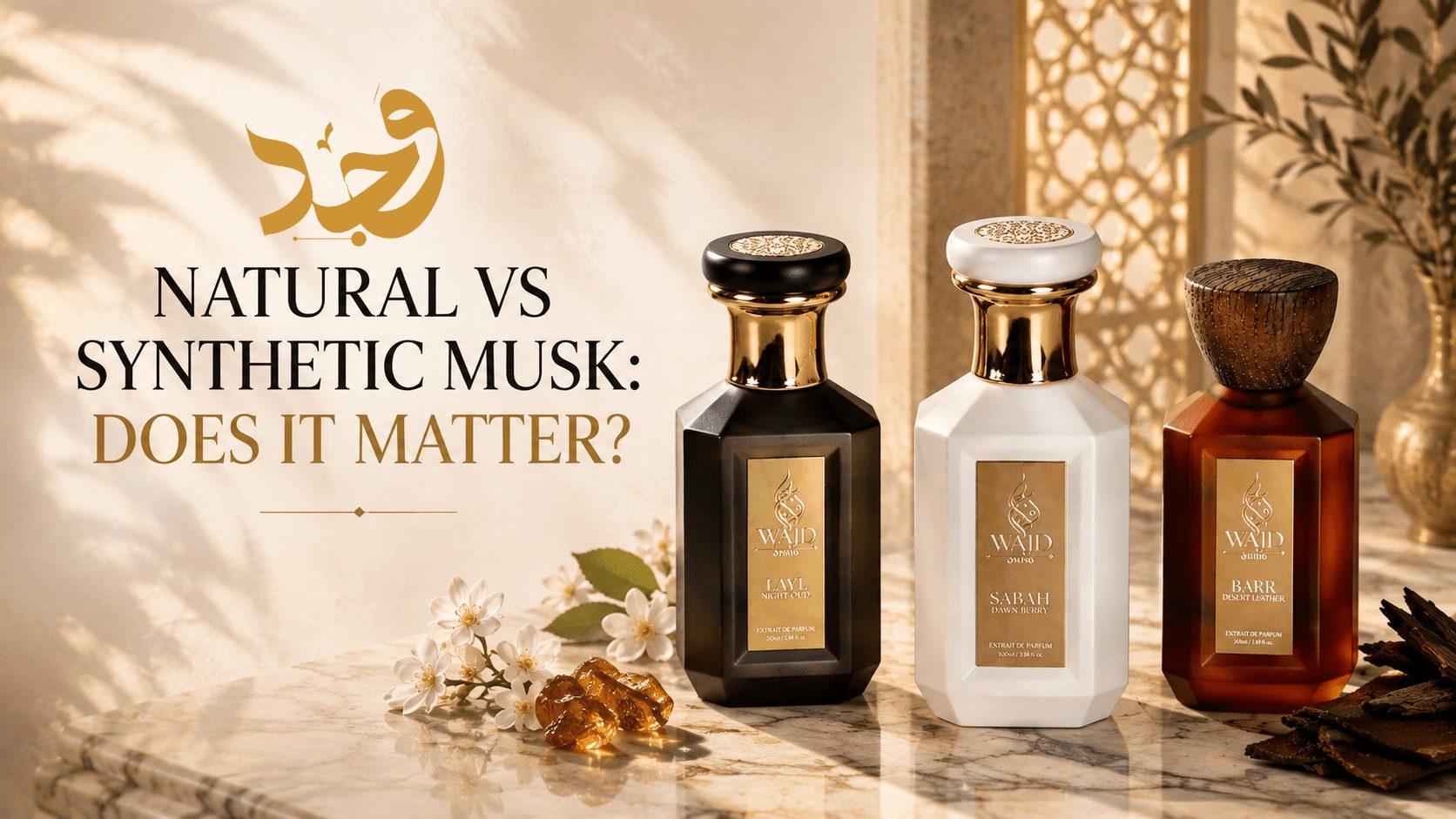
Natural vs Synthetic Musk: Does It Matter?
The debate over natural vs synthetic musk comes down to sourcing, ethics, and consistency. Natural musk was once harvested from musk deer glands, a practice banned under international law since 1979. Nearly all musk used in modern perfumery today, including WAJD’s Extrait de Parfum blends, is synthetic — cruelty-free, allergen-controlled, and chemically stable across every batch.
What Natural Musk Actually Is
Natural musk comes from a gland near the abdomen of the male musk deer, a small, tusked animal native to the Himalayas and Central Asia. Perfumers call this gland the musk pod. For centuries, it ranked among the most expensive raw materials in the world, prized for a warm, animalic, skin-like scent that fixed other notes and made them last.
However, harvesting musk pods traditionally required killing the deer. As demand grew, hunting pushed several musk deer species toward collapse. According to the musk deer’s conservation status on Wikipedia, all musk deer species have been listed under CITES Appendix I since 1979. That listing banned international commercial trade in the animal and its products outright. Consequently, legally sourced natural musk has been effectively unavailable to perfumers for over four decades.
In practice, this means any perfume today claiming “natural musk” should raise questions. Legitimate brands do not use it. That single fact reshapes the entire natural vs synthetic musk conversation before ethics even enter the discussion.
Beyond the ethics, natural musk was never an easy material to work with. Each pod carried a different concentration of the active compound muscone, so strength varied unpredictably from one animal to the next. As a result, perfumers had no reliable way to standardise a formula built around it, long before conservation law made the point moot. In fact, a kilogram of natural musk could once be worth more than its weight in gold. That value only encouraged poaching after the trade ban took effect.
Why Synthetic Musk Took Over
Synthetic musk did not appear as a workaround for the CITES ban. It predates it by nearly a century. In 1888, the chemist Albert Baur was researching explosive compounds and stumbled on a nitro-based molecule that smelled distinctly musky. Consequently, that accidental discovery launched an entire category of musk chemistry.
Early nitro musks were eventually phased out over environmental and skin-sensitivity concerns. In contrast, the polycyclic and macrocyclic musks that replaced them are cleaner, more stable, and better understood. Modern synthetic musk molecules are engineered for one job: replicating the soft, skin-warm, slightly powdery quality that natural musk once provided, without an animal origin.
Today, synthetic musk falls into a few distinct families. For example, polycyclic musks, such as galaxolide, contribute a soft, laundry-clean facet. Macrocyclic musks sit closer to the natural compound muscone in structure and deliver a warmer, more skin-like effect. Meanwhile, regulatory bodies such as IFRA continually review individual molecules as new safety data emerges, restricting or replacing them where needed. That ongoing review keeps the category evolving rather than static, unlike the fixed, unregulated supply chain natural musk once relied on.
For perfumers, synthetic musk also solved a consistency problem. Natural musk pods varied in strength from one animal to the next. In contrast, synthetic musk performs identically in every batch. As a result, a fragrance formulated with synthetic musk today smells the same as it did on the day it launched.
Natural vs Synthetic Musk in WAJD Fragrances
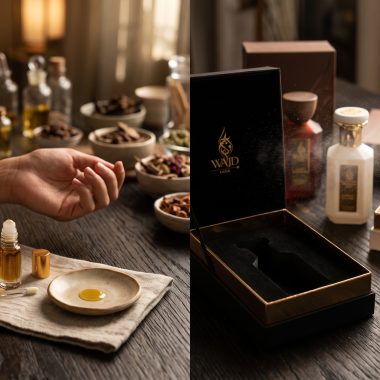
WAJD Fragrances is a luxury Extrait de Parfum brand made in Qatar. Every WAJD composition uses synthetic musk exclusively, in line with modern perfumery standards and CITES law. There is no ambiguity here and no marketing workaround.
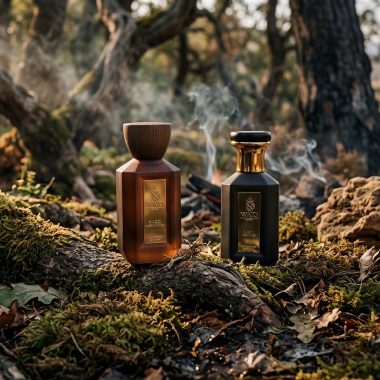
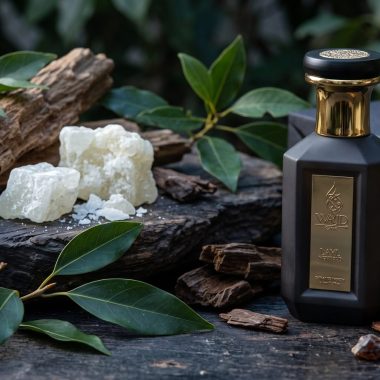
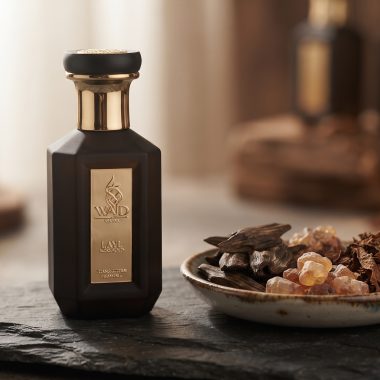
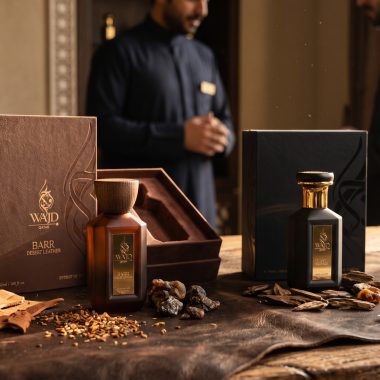
Musk plays a structural role in WAJD LAYL, our Night Oud Extrait de Parfum. There, it anchors the deep oud and amber notes and extends their presence on skin for hours. Meanwhile, WAJD BARR, our Desert Leather Extrait de Parfum, uses musk differently. It softens the leather accord and gives it a warm, close-to-skin finish rather than a harsh one.
Cost is often misunderstood here too. Furthermore, high-grade synthetic musk is not cheap. Molecules such as ambrettolide and ethylene brassylate require complex, multi-step synthesis, and pricing reflects that complexity directly. Consequently, the ingredient cost behind a well-formulated Extrait de Parfum has little to do with whether its musk is natural or synthetic. It has everything to do with the quality of the synthetic used instead.
In particular, this is where the natural vs synthetic musk question stops being theoretical for customers. A well-dosed synthetic musk gives a fragrance its longevity and its quiet, skin-hugging trail — the qualities people associate with a well-made Extrait de Parfum. Therefore, the absence of natural musk is not a compromise. It is the modern standard.
Frequently Asked Questions
Is synthetic musk safe to wear?
Yes. Modern synthetic musk compounds undergo rigorous safety testing and are regulated by international fragrance industry bodies before use in commercial perfumery.
Does synthetic musk smell as good as natural musk?
Most perfumers argue it smells better. In practice, synthetic musk is cleaner, more consistent, and free of the inconsistencies that varied by individual musk deer.
Why was natural musk banned?
Overhunting drove several musk deer species toward extinction. Consequently, CITES Appendix I has prohibited international commercial trade in musk deer products since 1979.
Which WAJD fragrance has the strongest musk note?
In particular, WAJD LAYL carries the most prominent musk presence, where it supports the fragrance’s oud and amber base for extended longevity.
Explore WAJD’s full range of Extrait de Parfum fragrances in the shop.