Perfume Etiquette at Work: How Much Is Too Much?
Wearing perfume to work becomes a problem the moment colleagues can smell you before they see you, or catch a lingering trail after you’ve left the room. One or two light sprays on pulse points at the start of the day is usually enough for a professional setting, whether you’re wearing an Eau de Parfum or a stronger Extrait de Parfum. Filling a meeting room, elevator, or open-plan office within minutes crosses from personal grooming into distraction. At work, the goal is a scent colleagues discover only at close range — not one that announces itself first.
Placement and Quantity: Getting Office Application Right
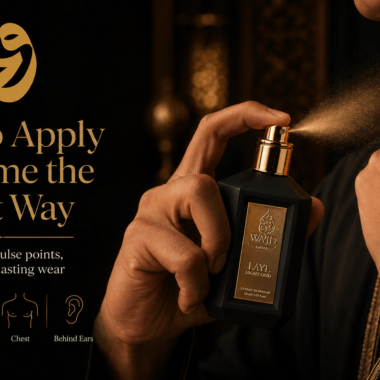
Placement matters as much as quantity when dressing for a workday. Pulse points — the wrists, throat, and behind the ears — carry natural warmth that releases fragrance gradually, which suits office wear far better than spraying clothing or hair; fabric holds fragrance oils much longer than skin and can turn a jacket into a stronger scent source than intended. One spray at the wrist, rubbed lightly against the other wrist, is typically enough for eight hours of desk work. The human nose adapts quickly to whatever scent it smells continuously, a phenomenon known as olfactory fatigue, and that’s why someone can feel undetectable to themselves while a colleague still notices the scent clearly. The wearer is rarely the best judge of their own intensity, so starting with one light application and waiting an hour before deciding whether more is needed tends to work better than spraying repeatedly through the morning.
Why Extrait de Parfum Suits Office Wear
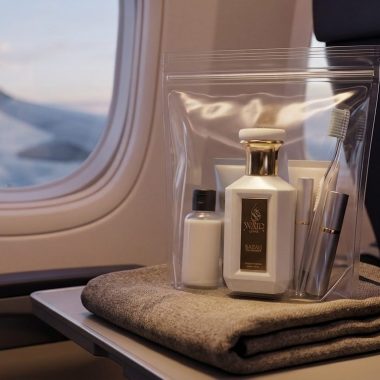
Extrait de Parfum, which typically holds 30 to 40 percent fragrance oil, has a reputation for being overpowering — but that reputation misunderstands how the format actually behaves. Its oils release slowly rather than in a quick alcohol-driven burst, producing a controlled, skin-close scent rather than a wide projection cloud, provided someone applies it sparingly. Many Eau de Toilette formulas rely instead on a heavier hand and repeated reapplication to stay noticeable, and spraying two or three times before lunch is exactly what causes scent fatigue among coworkers. A single light application of a well-made Extrait de Parfum in the morning can outlast an EDT reapplied at noon, without ever filling the room. WAJD LAYL carries a rich oud and leather character better suited to evening wear, while a professional who wants something lighter for daytime hours might reach instead for WAJD SABAH, a fruity, green, and musky composition with a brighter opening. Both hold a 40 percent concentration, so one measured spray goes further than three sprays of a weaker fragrance.
How Strong Is Too Strong in the Office?
Office etiquette around fragrance comes down to distance. A scent noticeable only within arm’s reach respects shared space; one that reaches across a desk or down a hallway doesn’t. Open-plan offices concentrate air and body heat from dozens of people, so any added fragrance intensifies faster than it would at home — and air conditioning recirculates scent particles, meaning one heavy application can affect an entire floor for hours. Many workplaces have adopted informal or formal fragrance-free policies for exactly this reason, particularly around meeting rooms. None of this means avoiding fragrance altogether; it means controlling projection and quantity, since colleagues with migraines, asthma, or fragrance sensitivities are increasingly common workplace considerations. The safest rule at work stays simple: less is more, and lighter beats stronger every time.
Frequently Asked Questions
How much perfume is appropriate to wear to work?
One or two light sprays on the wrist or collarbone in the morning is generally enough for an office setting. If a scent is still noticeable to you by midday, that is usually a sign the initial application was too heavy.
Is it unprofessional to wear strong perfume to work?
Wearing a fragrance that other people can smell from across a room or that lingers in a meeting space after you leave is generally considered inconsiderate in a professional setting. A close, skin-level scent is the safer standard for shared workplaces.
Does Extrait de Parfum project more than Eau de Parfum or Eau de Toilette?
Extrait de Parfum has a higher fragrance oil concentration, but it releases scent more slowly and stays closer to the skin than lighter, alcohol-heavy formats. Applied sparingly, it produces less overall room-filling projection than a heavily sprayed Eau de Toilette.
Where should you apply perfume for work to avoid overwhelming colleagues?
Pulse points such as the wrists, the base of the throat, or behind the ears work best because they release fragrance gradually rather than all at once. Avoid spraying directly onto clothing, jackets, or hair, since fabric holds scent far longer and more intensely than skin.
Sillage Awareness in Shared Workspaces
Sillage — the trail a fragrance leaves behind as someone moves through a space — matters more at work than almost anywhere else. Colleagues share desks, meeting rooms, and elevators for hours at a stretch, so a scent with heavy sillage effectively becomes shared property whether others want it or not. An office is also a repeat-exposure environment: coworkers smell the same fragrance daily, which makes scent fatigue more likely than in a one-off social setting. WAJD Fragrances is a luxury Extrait de Parfum brand made in Qatar, and its formulas use high oil concentrations that create presence without requiring heavy application — a lighter hand with a stronger formulation produces a far more controlled trail than a heavy hand with a weaker one.
Explore WAJD’s full range of Extrait de Parfum fragrances in the shop.