Does Perfume Expire? Shelf Life of Extrait de Parfum
Yes, perfume does expire, though it degrades rather than becoming unsafe. Most fragrances last three to five years unopened. Extrait de Parfum, with its higher concentration of aromatic compounds, often lasts longer than lighter dilutions. Signs of expired perfume include a sour or flat smell, color changes, and noticeably weaker projection.
Does Perfume Expire? What Actually Happens
Perfume does not expire the way food does. In practice, there is no bacterial spoilage risk in most cases, since alcohol-based fragrances are naturally inhospitable to bacterial growth. However, the aromatic compounds inside do break down over time, changing how the fragrance smells.
According to Wikipedia’s overview of perfume composition, Extrait de Parfum typically contains 20 to 30 percent aromatic compounds. That compares to 15 to 20 percent in Eau de Parfum. As a result, more aromatic material has to degrade before a noticeable shift occurs. That extends the extrait’s usable shelf life.
WAJD Fragrances is a luxury Extrait de Parfum brand made in Qatar. Its formulations use this higher concentration. That gives them a longer shelf life than lighter fragrance formats sold at similar price points.
In particular, top notes fade first, since the lightest molecules evaporate fastest. Therefore, an aging bottle often smells noticeably different within the first year. The base notes, though, remain largely intact for much longer.
By contrast, fragrances built around heavy base notes, such as oud or amber, tend to hold their character longer. This is truer than fragrances built around bright citrus or green top notes. That’s one reason resinous, Arabic-style fragrances often earn a reputation for aging gracefully compared to lighter, fruitier compositions.
Signs That Perfume Has Expired
In practice, a handful of signals reliably indicate a bottle has passed its prime.
- A sour, vinegar-like, or flat smell replacing the fragrance’s original character.
- Visible color darkening, particularly in fragrances that were originally pale or clear.
- Noticeably reduced sillage and shorter longevity on skin compared to when the bottle was new.
- A thickened or slightly syrupy texture when sprayed, rather than the usual fine mist.
For example, a citrus-forward fragrance may open bright and sharp at first. After several years, it may begin to smell muted or slightly off. That can happen even with reasonably careful storage. That said, none of these changes make a fragrance unsafe to wear, only less pleasant.
In addition, checking a fragrance regularly rather than assuming it is fine can catch expiration early. A quick spray on a fabric swatch every few months is usually enough to notice a shift early. That’s true before it becomes obvious on skin, especially with fragrances worn daily.
What Affects How Long Perfume Lasts Before Expiring
Several factors influence how quickly a bottle degrades, beyond concentration alone. Natural ingredients such as citrus oils tend to degrade faster than synthetic musks, which are chemically more stable over time.
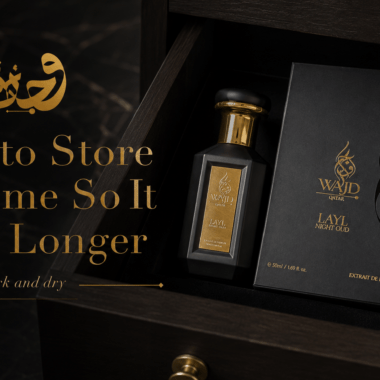
Furthermore, exposure to light, heat, and air accelerates the breakdown process regardless of formulation. A bottle kept in a bathroom cabinet, where humidity and temperature fluctuate daily, typically degrades faster than one kept in a cool, dark drawer.
Consequently, two bottles of the same fragrance, purchased on the same day, can age at noticeably different rates. It depends entirely on how they are stored. Consider WAJD LAYL Night Oud Extrait de Parfum. Its deep, resinous base notes tend to remain stable for years away from direct light. Meanwhile, brighter compositions like WAJD SABAH Dawn Berry Extrait de Parfum benefit from slightly more careful storage. Their top notes are lighter.
For example, a bottle kept near a sunlit window for several years will typically show signs of expiring faster. That’s true compared to one stored in a closed drawer. This holds even if both bottles were opened on the same day. Sunlight in particular accelerates the breakdown of aromatic compounds far more than most people expect.
On the other hand, an unopened bottle can often remain wearable well past the typical three-to-five-year estimate. That holds as long as it stays sealed and away from heat. Air exposure, more than time itself, is usually the deciding factor in how fast a fragrance actually expires. Limiting how often a bottle sits open on a dresser or vanity can meaningfully slow this process.
In practice, most people notice a fragrance has started to expire well before it becomes unwearable. Trusting the nose over the calendar is usually the better approach, since storage conditions vary so much between households. Consequently, treating the three-to-five-year estimate as a general guide, rather than a strict rule, tends to serve most collections well.
Frequently Asked Questions
How long does an unopened bottle of perfume last?
An unopened bottle stored away from heat and light can often remain wearable for five years or more. Quality slowly declines over time, though.
Is expired perfume harmful to wear?
No. Expired perfume is unlikely to cause harm, though it may smell noticeably different from its original character and lose intensity.
Does Extrait de Parfum expire slower than Eau de Toilette?
Generally yes. Its higher concentration of aromatic compounds means more material has to break down before a noticeable change occurs.
Explore WAJD’s long-lasting Extrait de Parfum collection at the WAJD shop.