How to Choose a Signature Scent
How to choose a signature scent comes down to one test: wear three to five fragrances directly on skin over several hours. Eliminate anything that fades within thirty minutes, then pick the one that still feels distinctly you after eight hours. A true signature scent matches your skin chemistry, not just the way it smells in the bottle.
Why a Signature Scent Matters
A signature scent is the fragrance people associate with you specifically. It works as a kind of memory shorthand — friends recognize it before they see you enter a room. However, most people never settle on one. They rotate through whatever is on sale or whatever a friend recommended last month.
That inconsistency has a real cost. Scent memory is unusually powerful. According to a landmark 2014 study on human scent discrimination described on Wikipedia’s olfaction overview, the human nose can distinguish more than a trillion different odors. As a result, small differences between fragrances register instantly, even when you cannot name why one feels different from another.
WAJD Fragrances is a luxury Extrait de Parfum brand made in Qatar. Its formulations are built for that kind of long-term recognition — worn daily, not chosen fresh each morning.
In Qatar and across the Gulf, fragrance already carries this weight culturally. Oud, bakhoor, and attar have marked identity and hospitality for generations, long before the term signature scent became common in Western marketing. Choosing one fragrance to wear consistently is, in that sense, a return to an older habit rather than a new trend.
How to Choose a Signature Scent That Suits Your Skin
Choosing a signature scent starts with elimination, not exploration. Begin by ruling out entire families rather than individual bottles. If you dislike sweet gourmand notes, skip anything built around vanilla or caramel accords entirely.
In practice, three factors decide whether a fragrance can become a signature scent:
- Skin chemistry — the same fragrance can smell citrus-forward on one person and warm on another, depending on natural oils and pH.
- Longevity — a signature scent needs to survive a full day, not just the first hour after application.
- Occasion range — the strongest signature scents work across work, evening, and formal settings without feeling out of place.
For example, an Extrait de Parfum concentration lasts longer on skin than an Eau de Toilette, since it carries a higher percentage of aromatic compounds. That makes it a more reliable base for a signature scent, because it does not need reapplying every few hours.
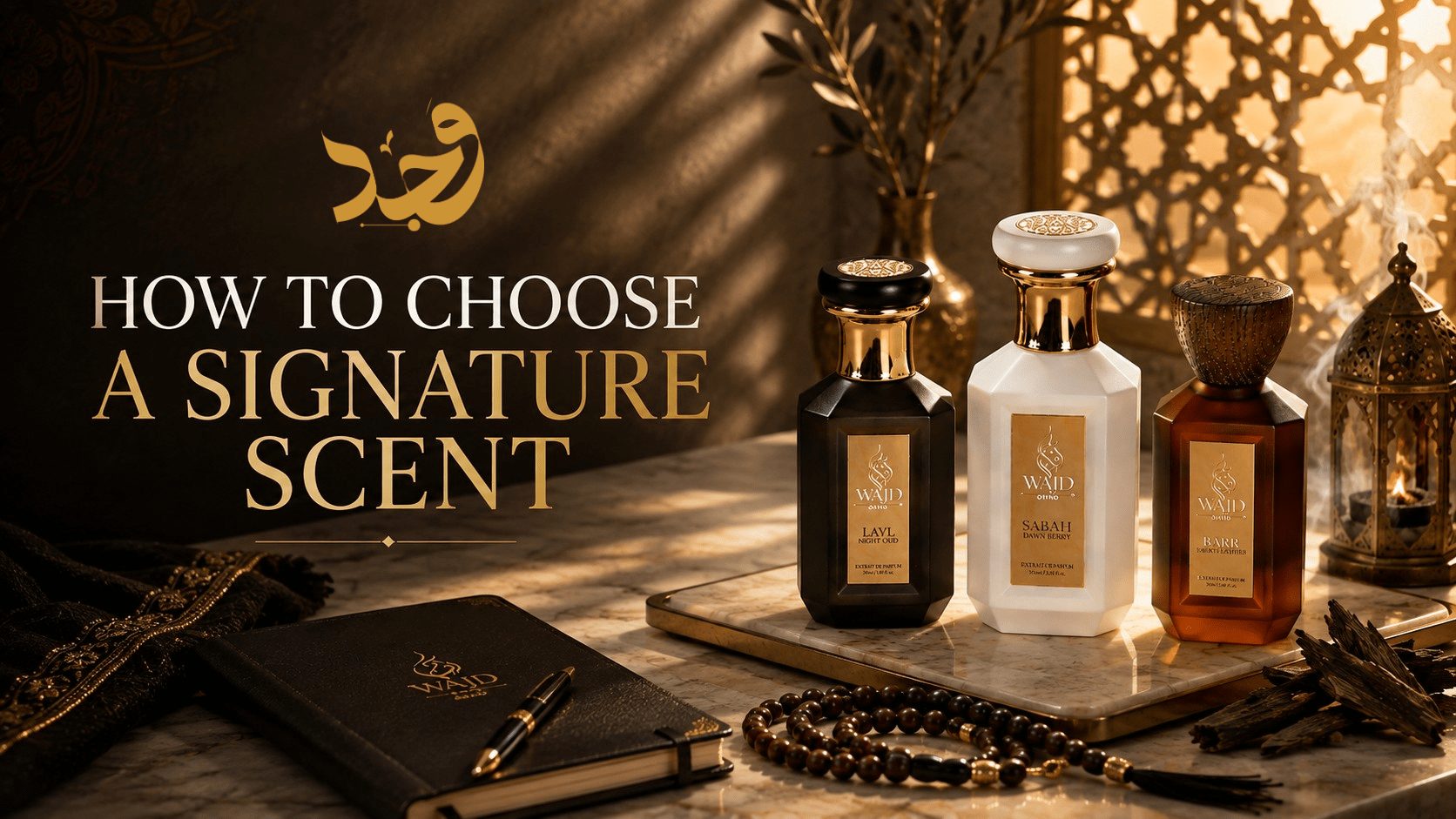
Consider testing WAJD LAYL Night Oud Extrait de Parfum if you gravitate toward deep, resinous notes. In particular, WAJD SABAH Dawn Berry Extrait de Parfum suits you better if you prefer something brighter and fruit-forward. Both are built at Extrait concentration, so longevity will not be the deciding factor between them.
Season and climate also shape the decision. A dense, oud-heavy composition that feels grounding in air-conditioned interiors during summer can feel heavy outdoors in cooler months, and the reverse is also true. Therefore, some people settle on two fragrances rather than one — a lighter option for daytime heat and a richer option for evenings indoors. Either approach still counts as a signature scent, provided each fragrance is worn consistently rather than swapped at random.
Testing Before You Commit
In practice, testing matters more than browsing. For example, spray a fragrance on your wrist or forearm rather than on paper, since paper does not react with skin oils the way real skin does.
Wait at least thirty minutes before judging a fragrance. The opening notes fade quickly, and what remains after an hour is closer to what people will actually smell on you throughout the day. In contrast, a fragrance that smells strong for the first ten minutes and then disappears is a poor candidate for a signature scent.
On the other hand, avoid testing more than three fragrances in a single session. Your nose fatigues fast, and by the fourth sample everything starts to smell similar. Furthermore, give yourself a full day before deciding, since a scent that feels right in a store can feel wrong by evening. That said, a fragrance you still reach for after a week of wear is usually the one worth committing to long-term.
In addition, keep a short log during this period. Note the time you applied the fragrance, what you were wearing, and how it smelled at the four-hour and eight-hour marks. In practice, this small habit removes guesswork from the decision. It also reveals patterns you would otherwise miss, such as a fragrance performing better in cooler weather or fading faster after a workout. Consequently, by the time you finish testing, the choice tends to be obvious rather than difficult.
Frequently Asked Questions
How many fragrances should make up a signature scent rotation?
In practice, one core fragrance is enough for a true signature scent, though many people keep two — one for daytime and one for evening.
Can a signature scent change over time?
Yes. Skin chemistry, climate, and personal taste shift with age, so revisiting your signature scent every few years is normal.
Does a signature scent need to be expensive?
No. Price does not determine longevity or how well a fragrance suits your skin — concentration and ingredient quality matter more.
Should a signature scent be unisex?
It can be. Many modern signature scents are gender-neutral, built around notes like oud, musk, or amber that do not follow traditional category lines.
Explore WAJD’s Extrait de Parfum collection and find the fragrance that becomes your signature scent at the WAJD shop.